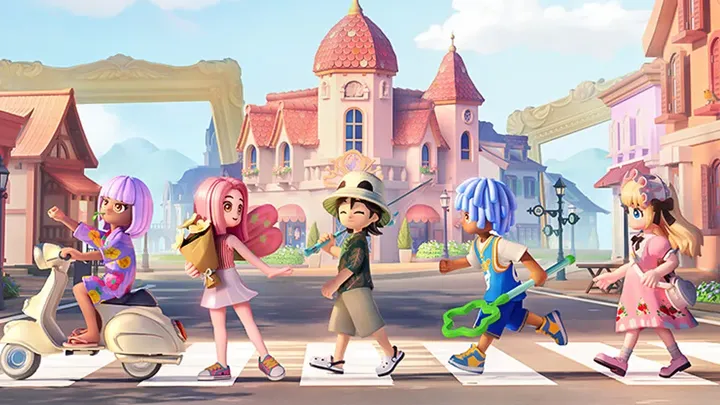







The modern landscape of cozy gaming has often been criticized for prioritizing aesthetics over depth. However, Heartopia emerges not merely as a life simulation, but as a digital sanctuary that explores the intersection of spatial design and emotional well-being. Unlike its predecessors that focus on the grind of accumulation, Heartopia pivots toward the philosophy of "Slow Living," where the environment reacts to the player's internal rhythm. This article delves into the intricate relationship between the game’s architectural freedom and the psychological concept of "The Third Place."

The Genesis of Digital Belonging: Beyond the Four Walls
At its core, Heartopia is an experiment in digital sociology. In the initial hours of gameplay, players are introduced to a world that feels intentionally porous—the boundaries between the private home and the public square are blurred. This design choice reflects a deep understanding of human connection; we do not just inhabit rooms, we inhabit atmospheres. The game utilizes a sophisticated lighting engine that shifts not just with the time of day, but with the communal "mood" of the server instance, creating a shared reality that feels alive.
The developers have integrated a system where the environment acts as a mirror. When a player engages in solitary activities, the soundscape narrows, focusing on the tactile noises of footsteps or rustling leaves. Conversely, as social density increases, the acoustic profile expands, simulating the "coffee shop effect." This subtle auditory engineering ensures that the player's sense of belonging is rooted in sensory experience rather than just visual feedback.
Architectural Fluidity: The Language of Personal Expression
In Heartopia, building is not a mechanical task but a linguistic one. The "Universal Grid" system allows for a level of customization that transcends simple furniture placement. Players utilize a modular design language that allows for the creation of spaces that are biologically intuitive. This isn't just about placing a chair; it’s about understanding how light hits that chair at 4:00 PM and how that specific ray of light contributes to the "hygge" of the room.
The Psychology of Spatial Layout
- Open Floor Plans: Encouraging a sense of freedom and transparency within the digital self.
- Nooks and Crannies: Designing for "Prospect and Refuge," a theory suggesting humans feel safest in spaces where they can see out but feel enclosed.
- Verticality: Utilizing height to represent ambition or a withdrawal from the "grounded" social world.
The Impact of Texture and Materiality
The game engine prioritizes the rendering of "soft" versus "hard" surfaces, which surprisingly impacts player dwell time. A room filled with velvet-textured assets and warm wood grains statistically keeps players in a state of "rest" longer than clinical, metallic environments.
The Chronology of Quietness: Time as a Narrative Device
Time in Heartopia does not function as a ticking clock of deadlines, but as a slow-moving river. As the day progresses from the soft pastels of dawn to the deep indigos of twilight, the game’s internal logic shifts the player’s focus. There is a chronological progression to the meaning of "home." In the morning cycles, the world feels full of potential and expansion, while the evening cycles invite introspection and the "closing" of the day’s emotional loops.
This temporal shift is crucial for the game's pacing. Most simulators use time to gatekeep content (e.g., waiting for a building to finish). Heartopia uses time to gatekeep feeling. Certain emotional beats and NPC interactions only trigger when the player has spent a significant amount of "real-time" stillness in a specific zone. It rewards the act of waiting, turning patience into a primary gameplay mechanic.
The Ecology of Shared Joy: Floral Dynamics and Growth
The gardening system in Heartopia is a sophisticated metaphor for community health. Each plant is not an isolated asset but part of a larger ecosystem that responds to the proximity of other players. This "Cross-Pollination of Presence" means that gardens thrive when they are visited, not just watered. The botanical variety serves as a visual history of a player's social interactions, with rare blooms appearing only after significant communal milestones.
Symbiotic Landscaping
- Pollinator Paths: Creating routes that guide other players through one's garden to trigger growth bonuses.
- Shared Plots: Areas where multiple players must contribute different "emotional essences" to cultivate a single, massive landmark.
Crafting the Intangible: The Alchemy of Scent and Sound
One of the most revolutionary aspects of Heartopia is its attempt to simulate the "unseen." Through visual cues and UI flourishes, the game mimics the impact of aroma and acoustics. When a player "cooks" or "brews" in their kitchen, a visual "scent aura" permeates the vicinity. This isn't just decoration; it changes the movement speed and animation sets of nearby players, causing them to move with more grace or relaxation.
Acoustic Architecture
Soundproofing and Resonance
Players can install materials that alter the reverb within a room. A library feels heavy and silent, while a grand hall carries the echoes of footsteps. This allows for the creation of "Meditation Zones" where the game's background music fades into a low-frequency hum, facilitating a genuine moment of zen for the person behind the screen.
Social Cartography: Mapping the Heart of the Community
As players interact, the world map literally changes. "Desire Paths"—small trails that appear on the grass where players walk most frequently—begin to form between popular houses. This creates an organic, player-driven geography. The town doesn't remain the static image designed by the developers; it becomes a living record of where people choose to spend their time together.
The significance of these paths cannot be overstated. They represent the collective unconscious of the player base. A well-worn path to a hidden cliffside suggests that the community values solitude and beauty, while a sprawling network of paths around a central fountain indicates a culture of vibrant, chaotic sociality. Heartopia allows the players to be the cartographers of their own social needs.
The Ritual of the Everyday: Finding Meaning in Small Actions
Heartopia elevates the mundane to the monumental. The act of making tea, organizing a bookshelf, or sweeping a porch is animated with such deliberate care that it becomes a ritual. This focus on "micro-interactions" prevents the game from falling into the trap of "end-game" obsession. In Heartopia, there is no end-game because the goal is the quality of the current moment.
This philosophy is baked into the animation system. Every action has a "warm-up" and a "cool-down" phase, forcing the player to move at a human pace. You cannot "teleport" through your life here; you must walk through it, experiencing every transition and every threshold.
Emotional Interiority: Designing for the Inner Child
The game provides a "Memory Gallery" where players can store snapshots of their favorite moments. However, these aren't just screenshots. The gallery tracks the emotional state of the world at the time the photo was taken. Re-visiting these memories can actually trigger the same lighting and weather effects from that moment within the player’s private sanctuary, allowing for a literal "reliving" of a feeling.
The Role of Nostalgia
- Legacy Items: Objects that can be passed between friends, carrying with them the "scent" and "aura" of their previous homes.
- Evolutionary Furniture: Pieces that show "wear and tear" based on how often they are used, adding a layer of wabi-sabi to the aesthetic.
The Convergence of Nature and Tech: The Digital Outdoors
Heartopia’s "wilderness" is not a place of danger, but a place of profound connection. The weather systems are synchronized across servers to create a feeling of global unity. When it rains in Heartopia, it rains for everyone. This shared "hardship" (though rain in this game is more of a cozy inconvenience) fosters a sense of collective endurance and the shared joy of seeking shelter.
The "Wild Growth" mechanic allows the forest to slowly reclaim areas that aren't maintained, encouraging a respectful relationship with the land. Players don't own the world; they lease it from nature. This subtle environmentalist undertone reminds players that they are part of a larger, breathing organism.
Conclusion: The Architecture of Kindness
Heartopia is more than a game; it is a blueprint for a kinder digital future. By prioritizing emotional resonance over mechanical efficiency, it provides a space where players can explore the nuances of their own personalities. The true depth of Heartopia lies in its silence—in those moments when you are doing nothing at all, yet you feel completely at home. It proves that in a world of constant noise, the most radical thing a game can offer is a place to breathe.
As we move forward into an era of increasingly complex virtual worlds, Heartopia stands as a reminder that the most important "feature" any game can have is a heart. It asks us to slow down, to look at the light on the wall, and to realize that we are never truly alone as long as we have a space to call our own.