






Introduction
Few games simulate desperation as convincingly as Kenshi. Set in a brutal post-apocalyptic wasteland, it is not merely a sandbox RPG about survival, faction warfare, or base building. Beneath its open-ended freedom lies a mechanical structure that quietly governs every action: hunger. While many survival games include food meters as light pressure systems, Kenshi transforms starvation into an invisible architect of social hierarchy, economic inequality, and player morality. Hunger in Kenshi is not just a timer—it is systemic oppression translated into mechanics.
This article examines how Kenshi’s hunger system shapes progression, social structures, faction dynamics, player behavior, and long-term worldbuilding. Rather than treating hunger as a background survival feature, we will explore how it functions as a narrative and mechanical backbone that reinforces the world’s cruelty.
1. The First Minutes: Hunger as Immediate Vulnerability
At the start of Kenshi, most character origins drop players into the world with minimal supplies. Hunger begins ticking almost immediately. Unlike games that give beginners a grace period, Kenshi presents starvation as a constant baseline.
Hunger drains steadily, reducing strength and combat effectiveness before eventually causing unconsciousness. Early on, players discover that fighting bandits or wandering without supplies quickly becomes impossible. Even looting requires calories. Movement consumes food; training consumes food; living consumes food.
This creates three immediate realizations:
- You cannot survive alone for long without income.
- Combat is expensive in calories.
- The world does not care if you starve.
From a systems perspective, hunger functions as a soft gate. It pushes players toward towns, factions, and employment. Isolation equals death. Community, even exploitative community, equals survival.
2. Labor and the Economics of Survival
Hunger directly feeds Kenshi’s labor loop. Early game survival often revolves around mining copper near towns. It is repetitive, slow, and dangerous. But it generates cats (currency), which buy food.
This is not accidental design—it mirrors wage labor dynamics.
Mining is low-risk but time-consuming. Time equals hunger drain. The longer you work, the more food you must purchase. This produces a subtle economic treadmill:
- Mine copper.
- Sell copper.
- Buy food.
- Repeat.
There is minimal upward mobility without significant risk. To escape this cycle, players must invest in combat skills, trade routes, or base construction—each of which requires even more food consumption during development.
The hunger system therefore enforces economic stratification:
- The strong can hunt and raid.
- The organized can farm.
- The weak must mine.
Hunger turns survival into employment.
3. Faction Power and Agricultural Control
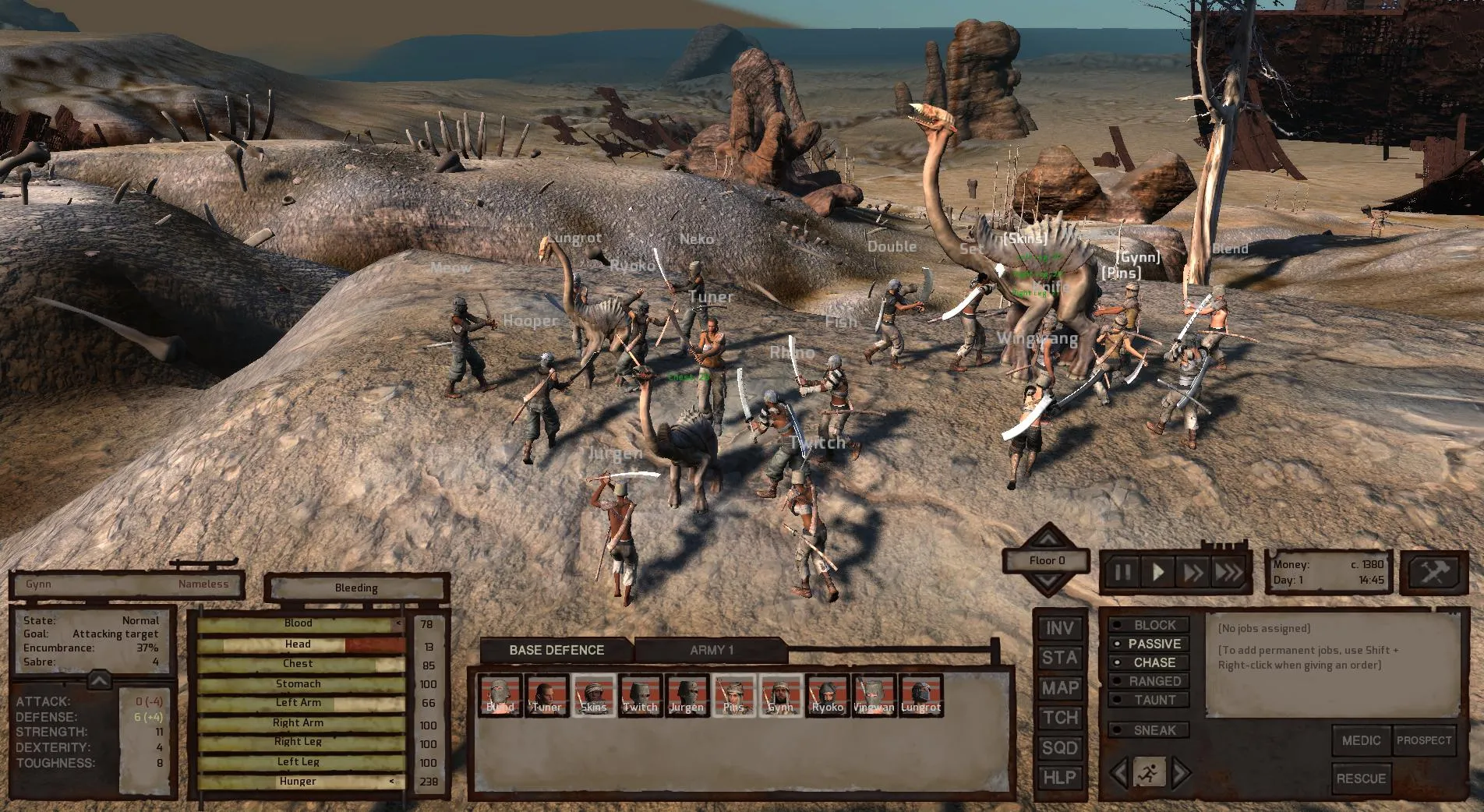
Major factions in Kenshi control fertile land and food production. The Holy Nation dominates river valleys. The United Cities tax trade routes. Shek Kingdom settlements rely heavily on warrior culture and tribute.
Food production determines political power.
Players who attempt to build independent bases quickly learn that farming requires water, fertility, labor, and defense. Crops fail in arid zones. Raids target food storage. Cannibals and bandits are drawn to agricultural settlements.
Hunger thus shapes geopolitics. Factions with arable land become stable states. Desert communities become nomadic or predatory. The map’s environmental hostility ensures that food surplus equals military leverage.
From a systemic standpoint, hunger reinforces environmental storytelling. The wasteland is not merely aesthetic—it defines who thrives and who starves.
4. Slavery as a Logical Outcome of Hunger
One of Kenshi’s most disturbing systems is slavery. Starving characters who are defeated may be captured and forced into labor camps. There, they are fed minimally to maintain productivity.
Hunger explains slavery’s logic.
Captors feed slaves just enough to prevent death. Labor camps operate as food distribution centers with coercive structure. Players who are enslaved experience hunger as control—obedience ensures meals; rebellion risks starvation.
This creates a morally complex gameplay loop:
- Escape while hungry and weak.
- Stay fed but oppressed.
- Use captivity as unintended training.
The hunger system makes slavery economically rational within the world’s brutal logic. It is not gratuitous—it emerges from scarcity mechanics.
5. Squad Management: Feeding the Collective
As players recruit more characters, hunger scales linearly. Each additional squad member increases food demand. This transforms the game from individual survival into logistical management.
Feeding a squad of ten requires planning:
- Stackable food types.
- Efficient inventory management.
- Cooking stations for ration optimization.
- Pack animals for transport.
Large squads can consume food faster than they can acquire it if poorly managed. This discourages reckless recruitment and forces strategic growth.
Hunger becomes a balancing tool. Power in numbers comes with supply strain. Expansion without infrastructure leads to collapse.
In this way, Kenshi models sustainability in a surprisingly systemic manner.

6. Cannibalism and Moral Degeneration
Certain regions are populated by cannibal factions. They attack settlements and devour captives. This is not merely horror flavor—it is the logical extreme of hunger scarcity.
When food systems fail, violence becomes agriculture.
Players themselves may resort to morally questionable strategies:
- Looting starving caravans.
- Raiding farms.
- Letting prisoners starve.
- Selling captives into slavery.
The hunger system creates moral pressure. Survival choices are rarely clean. Unlike scripted morality systems, Kenshi allows ethics to emerge from necessity.
Scarcity generates cruelty.
7. Automation and Agricultural Independence
Mid-to-late game progression often centers on building a self-sufficient base. Farming wheatstraw, greenfruit, or cactus becomes the cornerstone of independence.
But agriculture requires:
- Research.
- Skilled labor.
- Defensive structures.
- Water infrastructure.
- Processing chains (grain → flour → bread).
This production chain is intentionally complex. Hunger transitions from reactive management to proactive planning.
Players experience a pivotal moment when food storage finally overflows. That surplus changes everything:
- Combat expeditions become feasible.
- Training accelerates.
- Trade shifts from necessity to profit.
Food security equals freedom.
8. Strength Training and Caloric Investment
In Kenshi, strength increases faster when characters carry heavy loads. But carrying heavy loads increases hunger consumption. Thus, stat progression costs calories.
Training is literally an energy investment.
Players must calculate whether training during food scarcity is worth the risk. Hungry characters gain strength slower due to debuffs. Optimal growth requires stable food supply.
This is subtle but profound: physical development is economically gated by agriculture. The body is bound to logistics.
It reinforces the theme that power is not innate—it is sustained.
9. Environmental Determinism and Regional Starvation
Different regions in Kenshi impose environmental penalties. Acid rain, desert heat, and infertile soil directly influence food viability.
Some zones make farming nearly impossible. Others are constant battlegrounds. This environmental hostility forces migration and conflict.
Starvation is geographically distributed.
Settlements in fertile areas become political flashpoints. Nomadic groups emerge in hostile regions. The map itself becomes a hunger gradient.
Unlike many open-world games where geography is cosmetic, Kenshi ties survival probability directly to terrain fertility.

10. Late-Game Surplus and the Illusion of Stability
In the late game, players may achieve massive agricultural output. Hydroponics, automated farms, and heavily defended compounds create abundance.
Yet even then, hunger never disappears.
Raids can destroy crops. Drought cycles reduce yield. Trade disruptions cause shortages. Large squads still consume enormous resources.
The system ensures that food is never irrelevant. Stability is earned, not granted.
And when players revisit early mining towns after achieving surplus, they witness something striking: NPCs are still poor. Hunger remains systemic for the world even if the player escapes it.
This asymmetry reinforces Kenshi’s realism. The player does not fix the world—they simply carve a secure niche within it.
Conclusion
Kenshi’s hunger mechanic is not a superficial survival bar. It is a foundational system that shapes labor, politics, morality, faction warfare, and long-term progression. By tying physical capability, economic mobility, and social structure directly to food availability, the game constructs a simulation of systemic scarcity.
Hunger explains why factions oppress. It explains slavery. It explains nomadism, cannibalism, trade caravans, fortified cities, and agricultural wars. Every major system in Kenshi either responds to hunger or attempts to control it.
What makes Kenshi remarkable is not its difficulty but its consistency. Starvation is not dramatic—it is routine. And because it is routine, it becomes structural.
In the wasteland of Kenshi, power does not come from destiny or heroism. It comes from grain storage.
160-character summary:
An in-depth analysis of how hunger in Kenshi shapes labor, slavery, faction politics, morality, and long-term progression through systemic scarcity.